Long-Term Care is our core platform. Actively pursuing Pharmacy, Distribution & Consumer/Beauty acquisitions (EBITDA $600K+).
Are you ready to leave your business but do not want to let the future of your company be taken over by strangers? Well, an MBO (Management Buyout) provides a chance for management to take over. Management Buyout (MBO) refers to a transaction where the management of a company buys that company from the existing owner. The management of the company becomes the owner of the firm.
Owners may view this strategy as a viable path for succession or retirement. Unlike other conventional business transactions, the buyer is aware of all the procedures and knows its customers and the team. This guide examines how an MBO works, how it is financed, its valuation, and the risk factors involved. Owners seeking the best way of leaving their firms will find information on how an MBO works, how it is financed, and its risks useful. A management buyout meaning can be described as an act where the management of a company acquires the company from the current owner. This means that the management team becomes the new owner of the company.
This blog will provide information on what a management buyout is, how it is structured, financed, and valued, the process it follows, its advantages and disadvantages, and what business owners and managers need to take into account before doing a management buyout.
The managers employed by the company will become its owners through an MBO because they take possession of the company for themselves. This deal can be done for the entire company or the controlling interest only. The selling owner may continue to work in the company in an advisory role.
Normally, management does not have enough finances to make a buyout of the entire company. They will need to raise capital in the form of debt financing, equity, and sometimes also the seller. Due to financing through debt, an MBO turns into an LBO.
Owner wants to sell → Management shows interest → Company is appraised → Money is found → Terms are agreed → Due diligence process is completed → The purchase agreement is signed → Ownership transferred
MBO acquisition requires consensus between the management and the selling firm regarding the value, terms, financing, and other requirements of the deal before buying it. Both the owner and the management attempt to come to an agreement on valuation, while the buyers prepare for financing. Terms of the agreement are then negotiated and due diligence completed, followed by signing of the agreement by both sides. Typically, the buyers form a separate company for the purpose of buying.
The owner of the business might look at an MBO as part of his plan for retirement, succession, or any other form of exit plan. MBO can enable the owner to transfer the business without disrupting its culture, relationships, and the people working there. Instead of selling off the business to an outsider, the owner can hand over the business to someone from within the management who is familiar with it.
The managers have prior experience of the business, its customer base, and its employees. In addition, they are able to get the benefit of their growth through ownership rather than being an employee, and they have control over the strategy. The owners do not start the business from scratch.
Type of Transaction | Buyer | Objective |
Management Buyout | Management | Be the owner of the company |
Management Buy-In | Outside management group | Purchase and manage the company |
Strategic Acquisition | Other company | Growth/synergies |
Financial Acquisition | Investment company/investor | Invest and generate value |
Employee Buyout | Staff | Transfer ownership to employees |
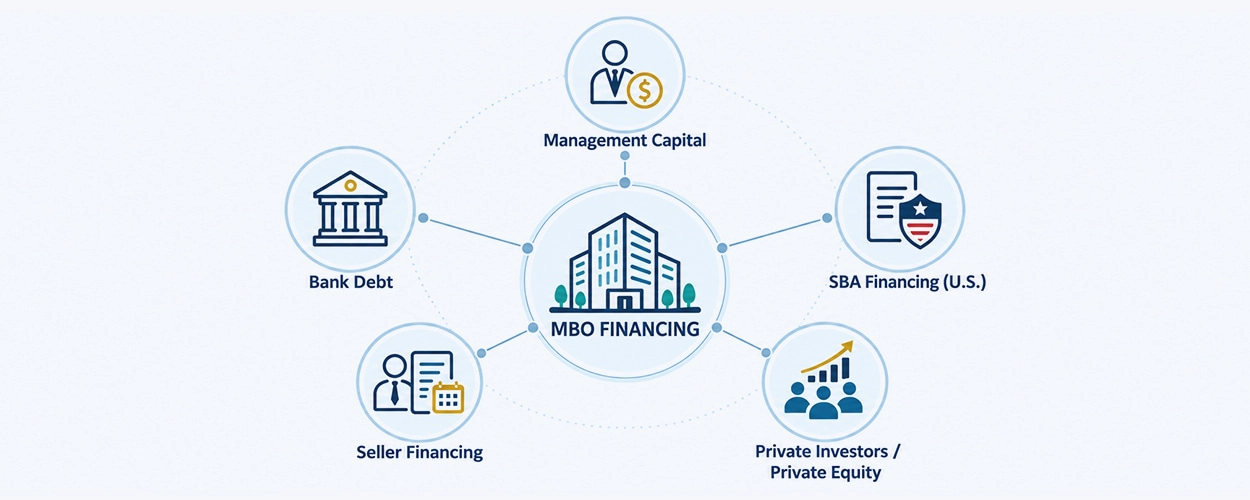
Management buyout financing usually uses several sources of finance that are needed by the management itself.
One must not confuse management buyout with management buy-in (MBI).
While MBO involves the existing management team acquiring the company, MBI involves another management team taking over the company and replacing the current one. The key distinction between MBO and MBI is who the new management and owner will be.
There are many reasons why an MBO can be used. For example, it could be used for business succession. In that case, an owner might be planning on retiring and wishing that the business stays with someone who knows how it works. Another reason is that an MBO will help to keep the culture and way of running the business. Because management already knows how the business works, there will not be as much disruption compared to bringing in new management.
From the perspective of management, the MBO will change their status from employees or executives to owners of the business.
From the perspective of the seller, the sale process will help them to exit the business without having to sell it to a competitor or an outside firm.
Due diligence usually includes accounting records, customer agreements, employee details, tax filings, debt arrangements, working capital, intellectual property, legal affairs, operating results, regulatory issues, and concentration of customers. Insider knowledge on the part of management is not a substitute for due diligence. Management should conduct its own review of the business “warts and all.”

The MBO does not necessarily represent a superior structure.
Management buyouts can make sense as an effective exit strategy if the business owner desires continuity and the managers have all their ducks lined up. This exit strategy is not necessarily always the most effective one, which means that comparisons must be made between it and other alternatives. STAR Capital is a platform for investing in and operating companies through strategic acquisitions with a focus on long-term care. In addition to this, we are also making acquisitions in multi-state pharmacies, wholesale distribution, and certain types of consumer/beauty products. Our target businesses are those generating at least $600,000 in EBITDA, and we generally do majority acquisitions.
If you are considering various exit strategies, send us an opportunity.
A Management Buyout is a process whereby the existing management buys out either partial or total shares of the company they manage.
MBOs can be funded through management’s resources, senior debt from banks, seller financing, private equity, and mezzanine finance.
In an MBO, the existing management team buys out the company, while in an MBI, the external management team buys out the company.
An entrepreneur can consider an MBO because it offers a viable way out for an entrepreneur to sell the company and maintain management continuity.
Some of the factors that should be considered before engaging in an MBO include valuation, financing, due diligence, management investment, terms of the deals, repayments, and change of ownership.

Whispering Winds RCH
37 Clarks Ave,
East Haven, CT 06512
Phone : 571-406-7827
Email: wwinfo@wwrch.com
42220 Sweet Court
Chantilly, VA 20152
Phone : 571-406-7827
104 Marylin Street
Goose Creek, SC 29445
Phone : 843-572-7442
SHULER HEALTH CARE
250 pitts street, kernersville,
NC, 27284
Phone : 336-996-0772
503 W Buncombe Street,
Roper, NC, 27970
Phone : 252-791-0002
ELTON RCH
30 W Main Street,
Waterbury, CT, 06702
Phone : 203-756-1229
Waterbury Garden RCH
128 Cedar Ave,
Waterbury, CT
Phone : 475-306-6888