Long-Term Care is our core platform. Actively pursuing Pharmacy, Distribution & Consumer/Beauty acquisitions (EBITDA $600K+).

Most business owners think about selling, refinancing, or bringing in a partner long before they actually do it. And the very first question that comes up is almost always the same one, how much is my business worth? It sounds simple, but the answer depends on a lot more than just your bank balance or last year’s revenue. If you have ever tried to put a number on your company and felt stuck, you’re not alone. This guide walks through what really drives a business’s value, how the process works, and what you can do right now to get a clearer picture. In this Star Capital blog learn your business’s real worth.
A lot of owners assume valuation is only for people who are ready to sell. That’s not true at all. Knowing your number changes how you make decisions, even if selling is years away.
When you know what your business is worth, you stop guessing you can plan for retirement, apply for a loan with realistic expectations, or decide if it’s the right time to expand. The importance of valuation shows up in everyday choices too, like whether to hire another employee or invest in new equipment, because you understand what that decision does to your company’s overall worth, not just this month’s cash flow.
Life happens. Partners leave, health issues come up, divorces happen, and sometimes an unexpected buyer just shows up at your door. Owners who already know their number can react calmly instead of scrambling to figure things out under pressure. It also helps when you’re negotiating with investors, since you won’t be caught off guard by a lowball offer.
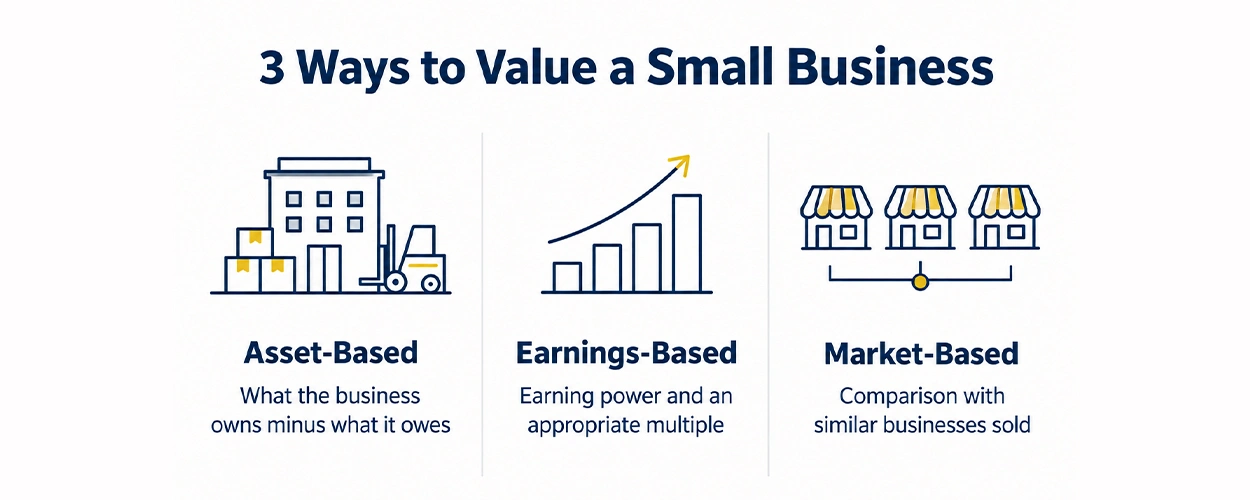
There isn’t one single formula that works for every company. Different industries and situations call for different approaches, and most professionals lean on a mix of these methods rather than just one.
This method adds up everything your business owns equipment, inventory, property, cash and subtracts what it owes. It works well for companies with a lot of physical assets, like manufacturing or retail businesses, but it tends to undervalue service-based companies where the real value sits in relationships, contracts, and reputation.
Here, the focus shifts to profit. Buyers usually look at your earnings and apply a multiple based on your industry, growth trend, and risk level. A stable business with loyal customers will usually get a higher multiple than one that depends heavily on a single client or one owner’s personal connections.
This approach compares your business to similar ones that have recently sold. It’s a bit like checking home prices in your neighborhood before listing your house. The tricky part is finding good comparable data, since small business sales aren’t always public, so this method often works best combined with the other two.
Knowing the methods is one thing. Actually applying them takes a bit of organization, but it’s not as overwhelming as it sounds once you break it down.
Start by pulling together at least three years of financial statements, profit and loss, balance sheets, and tax returns. Buyers and lenders trust clean, consistent records far more than a rough estimate scribbled on a spreadsheet. If your books are messy, this is the point where a bookkeeper can save you a lot of headaches later.
This step trips up more owners than you’d expect. Many small business owners run personal costs through the business, a car payment, a phone bill, a family member’s salary. A business expense calculator can help you sort out what’s truly a business cost versus a personal one, which gives you what’s called adjusted earnings. This number better reflects the real profitability a buyer would see.
Once your numbers are clean, pick the method (or blend of methods) that fits your industry best. A coffee shop with expensive equipment might lean on asset-based valuation, while a marketing agency with strong recurring contracts would likely rely more on earnings multiples.
Two businesses with identical revenue can have very different values. What separates them usually comes down to a handful of factors buyers care about deeply.
If one client makes up 40% of your income, that’s a risk in a buyer’s eyes, because losing that client could tank the business overnight. On the flip side, steady recurring revenue from a spread-out customer base makes a business feel safer and, in turn, more valuable.
If the business can’t run without you personally showing up every day, its value drops. Buyers pay more for businesses with trained staff, documented processes, and systems that don’t rely on one person’s memory or relationships.
You can estimate your business’s value on your own using the methods above, and that’s a great starting point. But when real money is on the line a sale, a legal dispute, bringing in investors it’s worth hiring a certified valuation professional. They bring objectivity, industry data, and a level of detail that protects you from underselling or overpricing your life’s work.
Figuring out how much your business is worth isn’t a one-time task you check off a list. It’s something that shifts as your revenue, market conditions, and industry change, so it helps to revisit the number every year or two. Whether you’re planning to sell soon or just want peace of mind, understanding your value puts you in a stronger position to make smart decisions for your business’s future. Understand what your business is worth and the factors that influence its value. Star Capital can help you assess your business valuation and make informed decisions about your next steps with confidence.
You can absolutely start on your own using earnings multiples or asset calculations as a rough guide. But for anything involving a real sale, loan application, or legal matter, a certified appraiser will give you a number that others will actually trust.
Once a year is a reasonable habit for most small businesses, though you should also recheck it after any major change, like a big new contract, a location move, or a shift in the market.
Mixing personal and business expenses together is probably the most common one. It inflates or deflates your real profit picture and throws off every calculation that follows.
Yes. Goodwill covers things like brand reputation, customer loyalty, and staff relationships that don’t show up on a balance sheet but genuinely affect what a buyer is willing to pay.
Definitely, most valuations use a multiple of profit, not just the raw number, so a business earning $150,000 a year could easily be valued at three, four, or five times that, depending on stability and growth potential.

Whispering Winds RCH
37 Clarks Ave,
East Haven, CT 06512
Phone : 571-406-7827
Email: wwinfo@wwrch.com
42220 Sweet Court
Chantilly, VA 20152
Phone : 571-406-7827
104 Marylin Street
Goose Creek, SC 29445
Phone : 843-572-7442
SHULER HEALTH CARE
250 pitts street, kernersville,
NC, 27284
Phone : 336-996-0772
503 W Buncombe Street,
Roper, NC, 27970
Phone : 252-791-0002
ELTON RCH
30 W Main Street,
Waterbury, CT, 06702
Phone : 203-756-1229
Waterbury Garden RCH
128 Cedar Ave,
Waterbury, CT
Phone : 475-306-6888