Long-Term Care is our core platform. Actively pursuing Pharmacy, Distribution & Consumer/Beauty acquisitions (EBITDA $600K+).

Selling a business sounds simple until you actually try to do it. You get a number in your head, you talk to a buyer or a broker, and suddenly the number they mention is nowhere close to what you expected. This happens more often than people think, and it usually comes down to one thing, the owner never worked on how to increase business value before selling. They ran the business well day to day, but they didn’t build it to be sold.
Buyers aren’t just paying for last year’s sales. They’re paying for how confident they feel that the business will keep making money once you’re gone. That confidence comes from specific aspects, clean records, a team that can run without you, consistent income, and streamlined operations with strong internal processes. In this Star Capital blog, you will learn how to increase the value of your business before selling and the key strategies that can help improve profitability, strengthen operations, and attract potential buyers.
Every serious buyer starts with financial records. Before they care about your product, team, or growth story, they want to see the numbers, and they want those numbers to make sense.
Separate Business Spending from Personal Spending
Plenty of small business owners mix the two without thinking much about it. A phone bill here, a car payment there, maybe a family member on payroll who isn’t really doing the job. It’s normal, but it hurts you later. It makes your actual profit look smaller, and it makes buyers wonder what else might be tangled up in there.
Cleaning this up a couple of years ahead of time gives buyers an honest picture of your earnings, which is one of the simplest ways to increase company value without changing anything about how the business actually operates.
Financial Clarity
You don’t have to be an accountant, but you should be able to answer basic questions about your financials on the spot. Why did costs spike in one quarter? If you fumble through answers like this, buyers start to worry, and worried buyers offer less.
One of the clearest ways to increase business value before selling is to improve profitability. Buyers are ultimately looking at how much money the business can generate and how consistently it can generate it. Strong revenue is important, but healthy profit margins and sustainable EBITDA can make a business more attractive to potential buyers.
Start by reviewing your pricing, operating expenses, labor costs, and product or service margins. Look for areas where costs have increased without adding meaningful value to the business. At the same time, avoid cutting expenses that are necessary for customer satisfaction, employee retention, or future growth.
It is also important to understand your EBITDA and what is driving changes in profitability. If earnings have improved, be prepared to explain why. If they have declined, identify the reason and determine whether the issue is temporary or ongoing.
Before selling, focus on building sustainable profitability rather than making short-term changes simply to make the numbers look better. Consistent earnings supported by efficient operations give buyers greater confidence and can strengthen your position during valuation and negotiations.
Many owners are surprised by how much their business depends on them. You might assume being deeply involved in everything makes the business look strong. To a buyer, it often looks like a warning sign instead.
Build Out a Team That Can Run Things
Write Down How Things Actually Work
A business that leans too hard on one client, one product, or one season feels fragile, even when the numbers look fine on paper. Spreading things out makes the whole business steadier and can help increase business value before selling.
Watch Your Client Concentration
Build in Recurring Revenue
Nobody wants to buy a mess. Cleaning up your operations shows a buyer they’re stepping into something stable, not something they’ll have to fix before they can even start growing it. Strong operations can also help increase business value before selling.
Reduce Costs That Add Little Value
Go through your expenses and be honest about what’s actually needed. Software nobody logs into anymore. Extra space you don’t use. Subscriptions that made sense three years ago and don’t now. Trimming this stuff doesn’t just help your profit margin, it also signals that you run a tight ship, which supports every effort to maximize business value going into a sale.
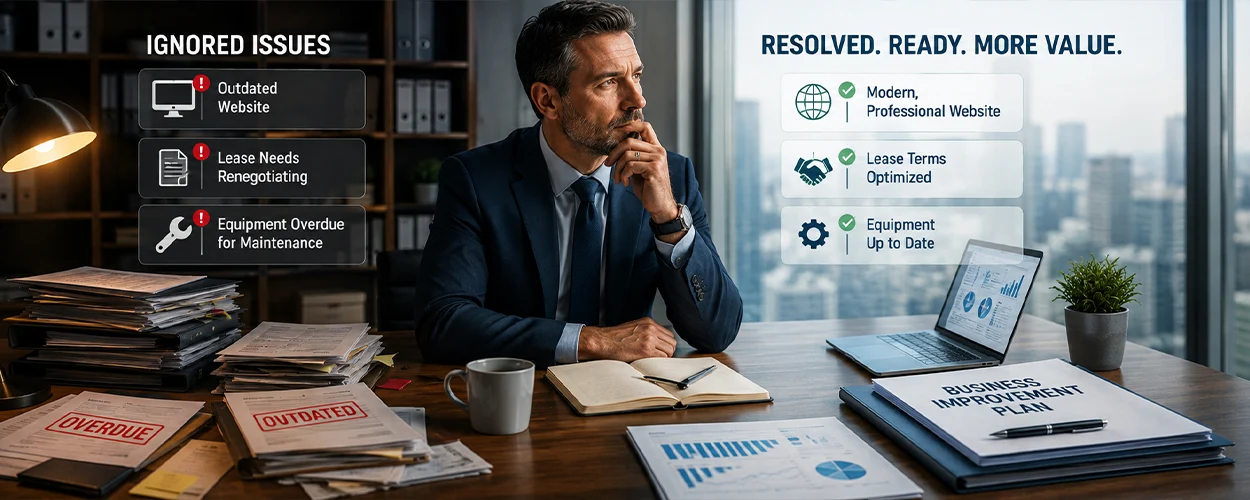
Resolve Business Issues Before Selling
Every business has a few things that have been quietly ignored. An old website. A lease that needs renegotiating. Equipment that’s overdue for maintenance. A buyer’s team will find these during due diligence one way or another, so fixing them on your own schedule beats having them used as leverage to knock down your price later.
Get a Business Valuation Before Selling
Getting a professional business valuation before selling helps you understand what your business may be worth and what factors are affecting its value. It can also highlight areas such as profitability, EBITDA, customer concentration, and owner dependence that may need improvement before approaching buyers. Knowing your business value early gives you time to address weaknesses and prepare for a stronger sale.
Start Business Exit Planning Early
Almost everything that raises value takes time to actually show up in your numbers. You can’t clean up two years of messy books in a month, and you can’t build a self-sufficient team overnight. Giving yourself two to three years before a planned sale gives these changes room to actually take hold, not just look good on a slide deck.
It also gives you time to get an early valuation, so you know where you actually stand instead of guessing. That way, when you do decide to sell, you’re fixing real gaps instead of hoping for the best.
None of this comes down to one big trick. It’s a mix of honest records, a team that doesn’t fall apart without you, income that isn’t riding on one client, and operations that don’t have obvious problems hiding. Put those pieces together, and you have done real work to increase business value before selling, not just hoping for a good offer and crossing your fingers. Start early, fix what needs fixing, and let the business speak for itself when the right buyer comes along. If you’re planning to sell your business, Star Capital is here to help. Our experienced team can guide you through the process and help you take the right steps to increase your business’s value before selling.
Most people in this space recommend starting two to three years out. That gives enough time for changes like better financial habits or reduced owner dependence to actually reflect in your numbers.
Yes, an early valuation shows you exactly where the gaps are, so you can spend your time fixing the things that actually affect your price instead of guessing.
You can, but expect it to slow things down and possibly cost you money. Spending a few months cleaning up your financials before you talk to buyers usually pays off.
Buyers backing out over trust issues, usually tied to messy financials or a business that seems too dependent on the owner to run without them.
Fix what you reasonably can before listing. Disclosing a problem without fixing it still gives buyers room to negotiate your price down, so handling it yourself protects you better.

Whispering Winds RCH
37 Clarks Ave,
East Haven, CT 06512
Phone : 571-406-7827
Email: wwinfo@wwrch.com
42220 Sweet Court
Chantilly, VA 20152
Phone : 571-406-7827
104 Marylin Street
Goose Creek, SC 29445
Phone : 843-572-7442
SHULER HEALTH CARE
250 pitts street, kernersville,
NC, 27284
Phone : 336-996-0772
503 W Buncombe Street,
Roper, NC, 27970
Phone : 252-791-0002
ELTON RCH
30 W Main Street,
Waterbury, CT, 06702
Phone : 203-756-1229
Waterbury Garden RCH
128 Cedar Ave,
Waterbury, CT
Phone : 475-306-6888