Long-Term Care is our core platform. Actively pursuing Pharmacy, Distribution & Consumer/Beauty acquisitions (EBITDA $600K+).
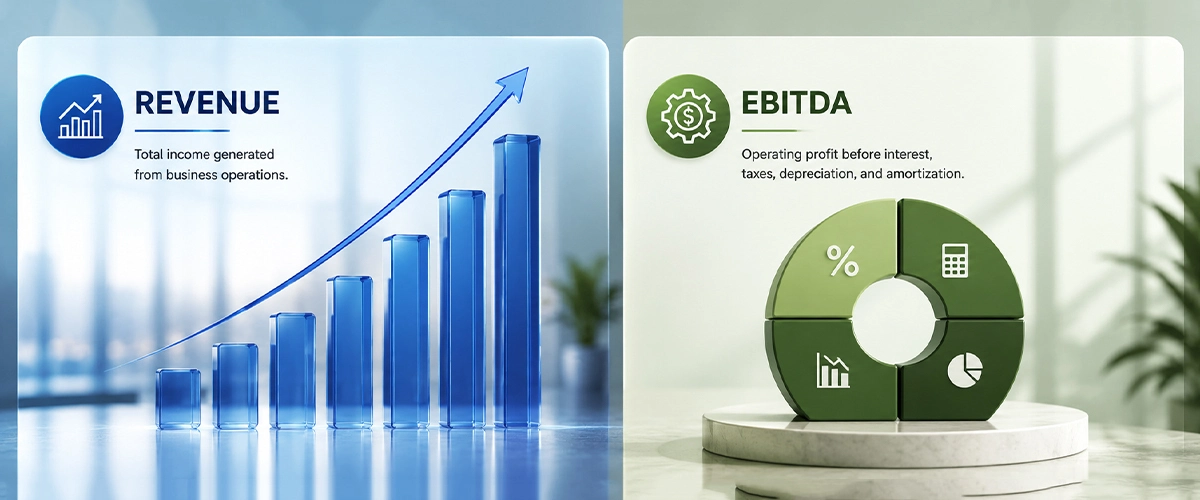
Most owners walk into a sale process thinking their revenue number is the headline. But when it comes to Revenue vs EBITDA, buyers rarely get excited about a big top line if the business barely makes money once you strip out the costs. This is where EBITDA (earnings before interest, taxes, depreciation, and amortization) comes in. Valuation enters the picture, and it’s usually the number that decides the purchase price, not the sales figure printed at the top of the income statement. If you’re planning to sell, or even just curious about what your company might be worth, understanding the difference between revenue and EBITDA will save you from some bad assumptions later. In this Star Capital blog, you will briefly learn the difference between revenue and EBITDA and understand which one matters more when selling a business.
From revenue, you will know how much money is coming. It says nothing about what it cost to bring that money in, or how much of it the owner actually got to keep. A company doing 5 million in sales with thin profit margins can be worth far less than a smaller company doing 2 million with strong profitability, buyers know this. They’re not purchasing your sales activity, they’re purchasing future cash flow. So when a seller leads with revenue, an experienced buyer usually moves straight past it and asks for the profit and loss statement instead.
A healthy growth rate does add value, especially if the business has recurring revenue and a clear path to more customers. But growth without profit is a warning sign, not a selling point. Buyers want to see that growth is translating into real operating income, not just bigger numbers on paper.

EBITDA stands for earnings before interest, taxes, depreciation, and amortization. In plain terms, it strips out financing decisions, tax situations, and accounting entries that don’t reflect actual cash performance, leaving behind a number that shows how the core business is doing. Buyers care about this because it lets them compare businesses on equal footing. Two companies can have wildly different tax structures or debt loads, but if their EBITDA is similar, their underlying operating performance is probably closer than the raw numbers suggest.
Most sales conversations don’t stop at plain EBITDA, they move to adjusted EBITDA. This adds back one-time expenses, owner perks, or unusual costs that won’t continue under new ownership. A seller might add back a one-off legal fee or a personal vehicle run through the business. Buyers will push back on some of these adjustments, and this back-and-forth often becomes one of the more detailed parts of due diligence.
Once EBITDA is agreed upon, buyers apply a valuation multiple to it. If a business has 1 million in adjusted EBITDA and the agreed multiple is 4x, the resulting value is roughly 4 million. This is one of the simplest and most widely used business valuation methods, partly because it’s easy to explain and partly because it reflects real market behavior. The EBITDA multiple itself isn’t fixed. It moves based on industry, company size, growth rate, customer concentration, and how replaceable the owner is in daily operations. A business that runs fine without the founder present usually earns a stronger multiple than one where the owner is doing most of the selling and decision-making.
Two companies with identical EBITDA can sell for very different amounts depending on risk. A business with recurring revenue, low customer concentration, and clean records will attract a higher earnings multiple than one that depends on a handful of clients or has messy financial records. Buyers are pricing risk as much as they’re pricing profit.
Revenue multiples aren’t meaningless, they show up in specific situations. Early-stage companies, software businesses with strong recurring revenue, or businesses that are pre-profit sometimes get valued on a revenue multiple because EBITDA isn’t a reliable indicator yet. For most established, profitable small and mid-sized businesses, though, EBITDA multiples are the standard. They give a buyer a clearer read on financial performance and expected return once the deal is structured and operating expenses are accounted for.
If the financial numbers and records are not accurate and well-organized, the rest of the preparation will not be as effective. Buyers will ask for financials going back several years, and any inconsistency slows the process or lowers the offer. Getting ahead of this is one of the most useful things a seller can do before going to market.
Normalized earnings, consistent bookkeeping, and clear documentation of operating expenses all speed up due diligence. When numbers are messy, buyers assume the worst and price that uncertainty into the deal structure, sometimes through a lower purchase price, sometimes through earn-outs or holdbacks tied to future performance.
Revenue vs EBITDA is an important comparison when preparing a business for sale. If you’re preparing for a sale, focus less on growing the top line for its own sake and more on building consistent, well-documented profitability. That’s what buyers pay for, and it’s the foundation of any credible EBITDA valuation. Plan Your Business Sale With Star Capital. Get expert guidance to help you prepare, attract the right buyers, and achieve the best possible outcome.
Generally yes, since a higher multiple means more enterprise value for the same EBITDA. But the multiple offered often reflects real business risk, so a low multiple can sometimes be a signal to fix operational issues before selling rather than just negotiating harder.
Yes, if profit margins are thin or the business relies heavily on the owner, buyers may hesitate even with solid sales numbers, since they’re ultimately buying future cash flow, not past revenue.
Most buyers request two to three years of financial history, sometimes more for larger deals, to confirm that profitability and growth rate trends are consistent rather than a single good year.
EBITDA shows how profitable a business is before certain costs. Cash flow shows the actual money coming in and going out of the business, including changes in working capital and money spent on equipment or other assets. They’re related but not identical, and buyers often look at both.
No, multiples vary widely by industry, company size, and growth prospects. A service business and a manufacturing company with the same EBITDA can still receive very different offers.

Whispering Winds RCH
37 Clarks Ave,
East Haven, CT 06512
Phone : 571-406-7827
Email: wwinfo@wwrch.com
42220 Sweet Court
Chantilly, VA 20152
Phone : 571-406-7827
104 Marylin Street
Goose Creek, SC 29445
Phone : 843-572-7442
SHULER HEALTH CARE
250 pitts street, kernersville,
NC, 27284
Phone : 336-996-0772
503 W Buncombe Street,
Roper, NC, 27970
Phone : 252-791-0002
ELTON RCH
30 W Main Street,
Waterbury, CT, 06702
Phone : 203-756-1229
Waterbury Garden RCH
128 Cedar Ave,
Waterbury, CT
Phone : 475-306-6888